
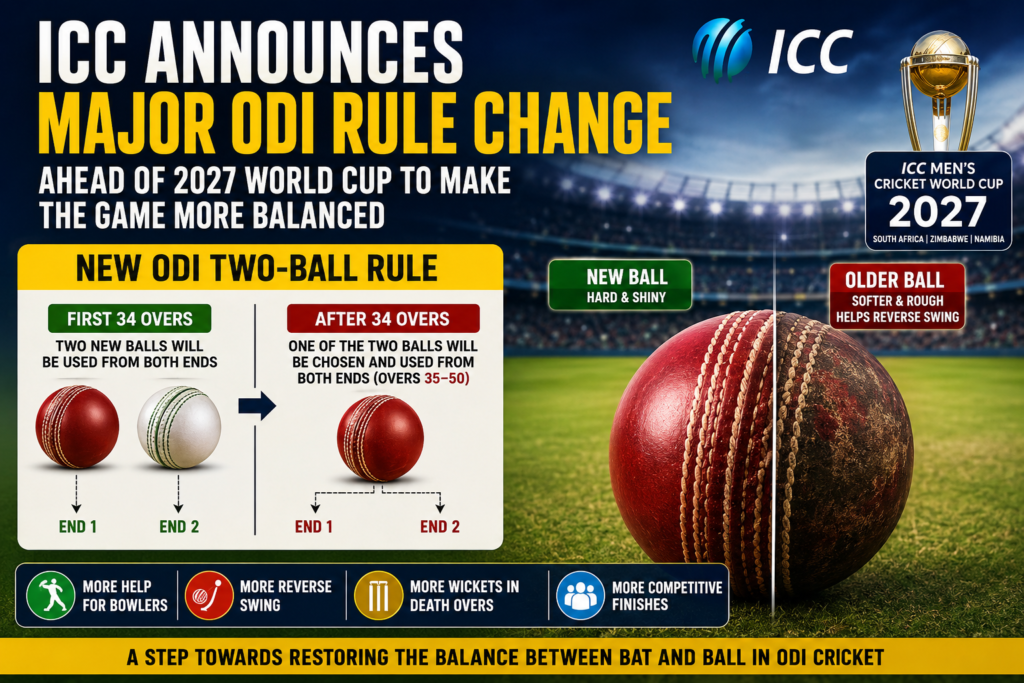
The International Cricket Council (ICC) has officially announced a major change to One Day International (ODI) cricket ahead of the highly anticipated 2027 ICC Cricket World Cup. The new rule is designed to create a better balance between bat and ball, a topic that has been heavily debated in modern cricket.
The updated ODI playing conditions mainly focus on the use of two new balls during an innings. Cricket experts, former players, and fans have often criticized the current system for heavily favoring batters, especially during the final overs of a match.
With the 2027 Cricket World Cup approaching, the ICC hopes this new rule will make ODI cricket more competitive and exciting for fans around the world.
What Is the New ODI Rule Change?
Under the existing ODI format, two new balls are used throughout the entire 50-over innings — one from each end. This means both balls remain relatively hard and shiny for most of the innings, giving batters an advantage and limiting reverse swing for bowlers.
New ICC ODI Ball Rule:
- Two new balls will continue to be used from both ends for the first 34 overs.
- After the 34th over, the fielding team will choose one of the two balls.
- That selected ball will then be used from both ends for the remaining overs (35 to 50).
This adjustment allows one ball to become older and rougher during the death overs, helping fast bowlers generate reverse swing and making batting more challenging in the final stages of an innings.
Why Did ICC Change the ODI Rules?
The ICC stated that the purpose of the change is to “restore balance between bat and ball” in ODI cricket.
In recent years, ODI matches have become increasingly batting-friendly due to:
- Flat pitches
- Shorter boundaries
- Powerful bats
- Two hard new balls throughout the innings
As a result, teams regularly score 350+ totals, while bowlers struggle to control run flow during the final overs.
The revised rule is expected to:
- Bring reverse swing back into ODI cricket
- Increase wicket-taking opportunities
- Improve death-over bowling strategies
- Create more balanced and competitive matches
How Will the New Rule Impact ODI Cricket?
Benefits for Bowlers
Fast bowlers are likely to benefit the most from the new rule. An older ball during the final overs can help bowlers:
- Generate reverse swing
- Bowl effective yorkers
- Control scoring rates
- Put pressure on batters in death overs
Benefits for Fans
Cricket fans may witness:
- More thrilling finishes
- Increased tactical battles
- Lower-scoring but more competitive games
- Greater importance of bowling skills
Impact on Batters
Batters may need to adapt their approach during the final overs, especially against reverse swing and changing ball conditions.
When Will the New ODI Rule Start?
The ICC has confirmed that the new ODI playing condition will come into effect from July 2025 and will be used in international ODI matches leading up to the 2027 Cricket World Cup.
The 2027 ICC Cricket World Cup will be hosted by:
- South Africa
- Zimbabwe
- Namibia
The tournament is expected to showcase the impact of the new rule on modern ODI cricket.
Cricket Experts Welcome ICC’s Decision
Many former cricketers and analysts have welcomed the ICC’s decision. Several experts had long argued that the two-ball rule removed traditional ODI bowling skills such as reverse swing and reduced the role of fast bowlers in the game.
The updated rule is being viewed as an important step toward making ODI cricket more balanced and entertaining again.
Final Thoughts
The ICC’s latest ODI rule change could significantly reshape the future of 50-over cricket. By allowing one older ball to be used during the final overs, the governing body aims to bring bowlers back into the contest and create a fairer balance between bat and ball.
As teams prepare for the 2027 ICC Cricket World Cup, players and fans alike will be watching closely to see how this major rule change transforms ODI cricket in the coming years.